
There’s a mistake even very experienced salespeople can make.
They sell to customers the way they themselves like to be sold to.
A fast-paced, results-focused salesperson gets straight to the point because that’s how they prefer people to communicate with them.
A relationship-focused salesperson spends time building rapport because that’s what makes them comfortable buying.
A highly analytical salesperson arrives with facts, specifications, comparisons and supporting evidence because that’s what they would want before making a decision.
And a patient, consultative salesperson gives the customer plenty of time because they dislike feeling pressured themselves.
None of these approaches is necessarily wrong.
In fact, each can be extremely effective.
With the right customer.
The problem is that your customers don’t all buy the same way.
And your best salespeople don’t all sell the same way either.
The salespeople who understand this have an enormous advantage because rather than delivering their preferred sales approach to every prospect, they learn how to recognise the person in front of them and adapt.
That’s where DISC can become an incredibly practical tool for sales professionals, account managers and sales leaders.
Stop Selling the Way You Like to Buy
Think about how you personally make an important purchasing decision.
Do you want someone to get straight to the point?
Do you prefer establishing a relationship before talking business?
Do you want time to consider your options?
Do you need to see the evidence, specifications and detail before you’ll commit?
Whatever your preference is, there’s a good chance it also influences the way you sell.
That’s human nature.
But there’s an important distinction between:
“This is how I like to communicate.”
and
“This is how my customer needs me to communicate.”
Successful behavioural selling is about recognising the difference.
Four Customers. One Proposal. Four Completely Different Reactions.
Imagine four potential customers are considering exactly the same proposal.
Customer One
They look at your presentation and ask:
“What’s the bottom line? What result will this deliver and how quickly can we get started?”
Customer Two
They lean forward and say:
“This sounds really interesting. Who else is doing this? Tell me how they’ve used it.”
Customer Three
Their first concern is:
“How will the change affect our people and what support will you provide during implementation?”
Customer Four
They ask:
“Can you send me the supporting data, specifications, implementation plan and a detailed comparison of the alternatives?”
Same product.
Same salesperson.
Same proposal.
Four very different buyers.
Now imagine giving all four customers exactly the same sales presentation.
That’s where opportunities can be lost.
Not because the salesperson doesn’t know the product.
Not because the salesperson isn’t experienced.
And not necessarily because the solution isn’t right.
Sometimes, the way the salesperson is communicating simply doesn’t match the way the customer wants to receive information and make decisions.
What DISC Can Teach Salespeople About Buyer Behaviour
DISC is a behavioural model based around four primary styles:
D — Dominance
I — Influence
S — Steadiness
C — Compliance
Most people are a combination of the four rather than fitting neatly into one category.
However, these behavioural preferences can influence how we communicate, interact with others, respond to pressure, approach problems and make decisions.
For salespeople, the value of DISC isn’t simply discovering:
“I’m a High D.”
or
“I’m an I/S.”
The real value comes from learning:
“How might my natural style affect the way I sell — and how do I adapt when my customer is very different from me?”
Let’s look at what that might mean in a real sales conversation.
Selling to a High-D Customer: Give Me the Bottom Line
A customer displaying strong Dominance behaviours will often be direct, fast-paced and focused on results.
They may quickly want to know:
What does it do?
What’s the commercial outcome?
How much does it cost?
How quickly can you deliver?
What do you need from me?
If your natural selling style involves slowly building the story, explaining every feature and providing extensive background before revealing your recommendation, you may lose their attention.
With a High-D customer, consider:
- Getting to the point
- Focusing on outcomes
- Being confident and direct
- Presenting clear options
- Avoiding unnecessary detail
- Respecting their time
- Allowing them to feel in control of the decision
They can always ask for more information if they want it.
A strong D often wants to understand where we’re going, not every turn in the road.

Selling to a High-I Customer: Make the Conversation Engaging
A customer displaying strong Influence behaviours may be enthusiastic, optimistic, expressive and people-oriented.
They may enjoy discussing ideas, possibilities and experiences.
Start the meeting with a 35-slide technical presentation and you could struggle to create engagement.
Instead, consider:
- Building genuine rapport
- Asking about their ideas and goals
- Making the conversation interactive
- Demonstrating enthusiasm
- Using relevant stories and examples
- Focusing on possibilities and the bigger picture
- Allowing room for discussion
This buyer may make the meeting feel very positive.
But here’s an important trap for the salesperson.
Enthusiasm isn’t necessarily commitment.
A great conversation still needs a clear next step.

Selling to a High-S Customer: Build Trust Before Applying Pressure
Customers displaying strong Steadiness behaviours may place significant value on trust, consistency, relationships and support.
They may want to understand how a decision will affect them and the people around them.
Aggressive closing techniques can easily backfire.
A salesperson who continually asks:
“What would it take to get this signed today?”
or
“If I can get that approved, will you commit now?”
may believe they’re creating urgency.
The customer may experience it as pressure.
Instead, consider:
- Listening carefully
- Demonstrating reliability
- Explaining how implementation will work
- Providing reassurance around support
- Giving appropriate time to process change
- Avoiding unnecessary pressure
- Building confidence in the relationship
That doesn’t mean you shouldn’t ask for the business.
It means recognising that how you ask matters.

Selling to a High-C Customer: Show Me the Evidence
Customers displaying strong Compliance behaviours may value accuracy, logic, evidence, quality and detail.
They’re likely to ask questions.
Sometimes a lot of questions.
The inexperienced salesperson may interpret this as resistance.
It may be nothing of the sort.
The customer could simply be gathering the information they need to make a confident decision.
With a High-C customer, consider:
- Being well prepared
- Providing relevant facts and evidence
- Answering questions accurately
- Avoiding exaggerated claims
- Providing supporting information
- Allowing time for analysis
- Following through on commitments
Saying:
“Don’t worry about all the detail — trust me”
is unlikely to help.
Give them enough information to reach their own conclusion.

Your Intention Isn’t Always the Customer’s Experience
This is where behavioural selling becomes particularly interesting.
Imagine an enthusiastic salesperson finishing a presentation to an analytical customer.
The salesperson leaves thinking:
“That went brilliantly. We had a fantastic conversation.”
The customer leaves thinking:
“I didn’t get enough information to make a decision.”
Or a technically strong salesperson gives an extremely comprehensive presentation to a fast-paced customer.
The salesperson thinks:
“I covered absolutely everything.”
The customer thinks:
“Why couldn’t they just tell me the answer?”
Or a very assertive salesperson continually pushes a relationship-focused customer for the close.
The salesperson thinks:
“I’m creating urgency.”
The customer thinks:
“I’m being pressured.”
That’s one of the most important lessons in sales communication:
Your intention and your customer’s experience aren’t always the same thing.
There Is No Perfect DISC Profile for Sales
Sales Managers sometimes ask:
“What’s the best DISC profile for a salesperson?”
There isn’t one.
Different behavioural styles can bring very different strengths.
A strong D may bring drive, competitiveness, confidence and a willingness to ask for the business.
A strong I may excel at networking, building rapport, creating enthusiasm and influencing others.
A strong S may be an exceptional listener who develops trusted, long-term customer relationships.
A strong C may bring preparation, product knowledge, accuracy and credibility — particularly in complex or technical sales.
Most successful salespeople will also have combinations of these behaviours.
The more useful question is:
How can this salesperson maximise their natural strengths while developing the flexibility to sell effectively to customers who are very different from them?
That’s a much more powerful sales development conversation.
The Most Dangerous Sales Style May Be an Inflexible One
Experienced salespeople often develop an approach that works.
That’s a good thing.
Until it becomes the only way they sell.
Over time, successful behaviour can become habitual.
A salesperson finds an approach that has produced results for years, so naturally they continue using it.
But what happens when they meet a customer who doesn’t respond to that approach?
They might conclude:
“They’re difficult.”
“They’re only interested in price.”
“They weren’t serious.”
“They don’t understand the value.”
Sometimes that’s true.
But sometimes the customer simply wasn’t being sold to in a way that matched how they preferred to communicate and make decisions.
The objective isn’t to abandon your natural selling style.
It’s to develop behavioural flexibility.
Great salespeople notice what’s happening in front of them and adjust.
Start by Understanding Your Own Sales Behaviour
Before you can become better at reading customers, it helps enormously to understand yourself.
The DISC Sales Profile is designed specifically for salespeople, account managers and business development professionals.
Rather than providing generic behavioural information, the profile examines how an individual’s DISC style can influence areas of the sales process such as preparation, presentation, handling objections, closing and follow-up.
It can help salespeople identify:
- Their natural selling strengths
- Their preferred communication style
- Potential blind spots
- How their behaviour may change in the work environment
- How they approach different stages of the sales process
- Areas for development
- How to adapt their communication to different customer styles
For many salespeople, the valuable question becomes:
“Could some of the things that make me successful with one type of customer be getting in my way with another?”
Learn more about the DISC Sales Profile →
Want to Go Deeper? DISC Sales TriMetrix
For organisations wanting deeper insight into experienced salespeople, account managers or sales leaders, we also offer the TriMetrix Sales/Account Management Profile.
DISC helps us understand how a person behaves.
TriMetrix takes the assessment further by combining three sciences:
DISC — Behaviours
How does this person naturally approach situations and communicate?
Driving Forces — Motivators
What drives and energises their decisions and behaviour?
Emotional Intelligence — EQ
How effectively do they recognise and manage emotions in themselves and their interactions with others?
For senior salespeople, Key Account Managers, Business Development Managers and Sales Leaders, this deeper insight can provide an extremely valuable foundation for coaching and development.
Explore the TriMetrix Sales/Account Management Profile →
Now Look at the Whole Sales Team
Individual profiles tell one story.
Put the entire sales team together and another story can emerge.
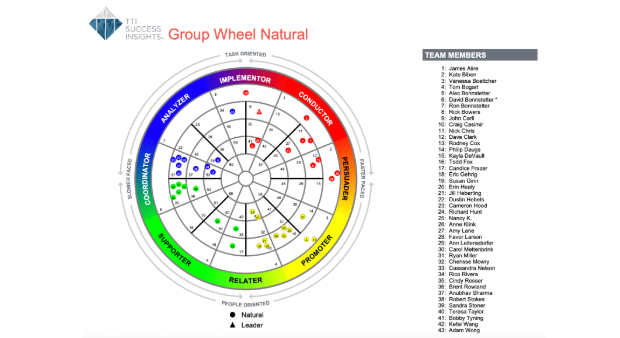
A DISC Behavioural Team Report provides a visual picture of the behavioural styles represented across a team.
This can lead to some fascinating questions for Sales Directors and Sales Managers.
Is our sales team heavily weighted towards one behavioural style?
Do we have a team that’s great at generating opportunities but less consistent with follow-up?
Are we excellent at maintaining existing relationships but reluctant to challenge customers or pursue new business?
Are we commercially aggressive but sometimes moving too quickly for certain customers?
Are we technically excellent but providing far more detail than some buyers want?
Do our salespeople all tend to approach customers in a similar way?
There isn’t necessarily a right or wrong team composition.
The value is in understanding what you’ve got.
Once a Sales Manager can see the behavioural make-up of their team, coaching becomes much more specific.
Learn more about the DISC Behavioural Team Report →
A Profile Is Useful. Applying It to Customers Is Where It Gets Powerful.
Completing a DISC profile can create valuable self-awareness.
But the real commercial value comes from application.
That’s why, in our facilitated Sales and Account Management workshops, we move beyond simply understanding the four DISC styles.
We teach participants to start recognising behavioural clues in customers.
Consider the customer you’re meeting next week.
Before you even know their DISC profile, there may be clues.
How quickly do they communicate?
Are their emails short and direct or comprehensive and detailed?
Do they ask primarily about results?
Do they want to discuss ideas?
Do they focus on how implementation will affect their people?
Do they ask for facts and evidence?
Do they make decisions quickly?
Do they want time to consider things?
Do they enjoy conversation or prefer getting straight to business?
Every one of those observations provides information.
The salesperson then has choices.
Speed up.
Slow down.
Give more detail.
Give less detail.
Ask another question.
Stop talking.
Focus on results.
Focus on the relationship.
Provide evidence.
Provide reassurance.
That’s when DISC stops being a personality profile and starts becoming a sales tool.
Try This With Your Next Customer Meeting
Before your next important sales call, ask yourself five questions.
1. How does this customer prefer to communicate?
2. What appears most important to them — results, people, security or detail?
3. How quickly do they appear comfortable making decisions?
4. What might I naturally do in a sales meeting that could frustrate them?
5. What could I change in my approach to make it easier for them to engage with me?
That final question is particularly important.
Instead of asking:
“How do I get this customer to buy?”
try asking:
“How can I make it easier for this customer to understand the value of what I’m offering?”
That’s a very different mindset.
Sales Managers: Listen to Your Team’s Lost-Deal Explanations
There is another useful application for Sales Managers.
The next time you’re reviewing a lost opportunity, listen carefully to the language being used.
“They were impossible to read.”
“They kept asking for more information.”
“I couldn’t get them to make a decision.”
“They wouldn’t open up.”
“All they wanted to talk about was price and results.”
“They seemed interested, but nothing happened afterwards.”
Don’t only ask:
“What went wrong with the deal?”
Also ask:
“What was the customer’s behavioural style, and how did we adapt our sales approach to them?”
It can create a much more valuable coaching conversation.
Your Customer Isn’t You
Perhaps the biggest lesson is also the simplest.
Your customer isn’t you.
They don’t necessarily want the information you would want.
They don’t necessarily make decisions the way you make decisions.
They don’t necessarily respond to urgency the way you do.
They don’t necessarily want the same level of detail.
They don’t necessarily value the same things first.
And they don’t necessarily define a “good salesperson” the same way you do.
Great salespeople don’t become four different people.
They become more observant.
More self-aware.
More adaptable.
They learn when to talk.
When to listen.
When to challenge.
When to reassure.
When to provide detail.
And when to simply get to the point.
How The DISC Agency Helps Sales Teams Sell More Effectively
At The DISC Agency, we work with Sales Teams, Account Managers, Business Development professionals and Sales Leaders across Australia to build greater behavioural intelligence into the way they sell and manage customer relationships.
Depending on the objectives of the organisation, we can use:
DISC Sales Profile
Individual behavioural insight specifically focused on the sales process, communication and buyer adaptation.
DISC Sales TriMetrix
A deeper assessment combining DISC behaviours, Driving Forces and Emotional Intelligence for sales and account management development.
View the TriMetrix Sales/Account Management Profile →
Behavioural Sales Team Report
A team-level view that helps Sales Leaders understand behavioural strengths, differences and potential gaps across their sales function.
View the DISC Behavioural Team Report →
Facilitated DISC Sales & Account Management Workshops
We bring the profiles to life through practical, facilitated training focused on applying DISC to real customer conversations, communication, behavioural profiling, sales relationships and account management.
Explore our DISC Sales & Account Management Workshops →

Could Your Sales Team Benefit From Greater Behavioural Intelligence?
If your organisation is reviewing sales training, account management development or looking for a fresh way to improve customer communication, we would be happy to show you what behavioural profiling could look like for your team.
You don’t need to commit to a workshop to start the conversation.
Ask us for sample reports of the DISC Sales Profile, DISC Sales TriMetrix or Behavioural Sales Team Report and we can talk you through the differences and which approach may best suit your sales team.
Because your best salespeople don’t need to sell the same way.
They need to know when to sell differently.
Contact The DISC Agency
1300 690 469
support@thediscagency.com.au