By John Wright, Senior Partner – The DISC Agency
Your sales team is busy. Your CRM is full of activity. Your salespeople are attending meetings, preparing proposals and following up opportunities. So why aren’t more deals converting?
It’s a question that frustrates Sales Directors, General Managers, Business Owners and Sales Leaders across Australia.
When a sales team consistently falls short of its revenue targets, the usual response is predictable.
Generate more leads. Increase call activity. Run another sales training session. Review the pipeline. Apply more pressure to close.
But what if the real problem isn’t the number of opportunities entering your sales pipeline?
What if your salespeople and account managers simply don’t know the most effective strategy to use at critical stages of the sales process?
And perhaps more importantly, how would you know?
That’s where the Target Selling Insights™ (TSI) Individual Assessment and Target Selling Insights™ Group Report from TTI Success Insights provide a different approach to evaluating and developing sales teams.
Together, these two reports help organisations answer three important questions:
- Does each salesperson or account manager understand the strategies required to sell effectively?
- Where are the individual strengths and knowledge gaps that need attention?
- How does the entire sales team compare across the different stages of the sales process and against the report’s top-performer reference benchmarks?
Rather than investing in another generic sales training programme, organisations can use these insights to identify specific sales knowledge gaps and develop targeted coaching.

Because you can’t effectively improve what you haven’t properly evaluated.
What Is a Sales Team Assessment and Why Does It Matter?
A sales team assessment is a structured way of evaluating the capabilities, knowledge and development needs of sales professionals.
Sales performance is traditionally measured through commercial indicators such as revenue, sales targets, conversion rates, pipeline activity, average deal value and customer retention.
These are important metrics. However, they primarily measure outcomes.
They don’t necessarily explain why one salesperson consistently converts opportunities while another struggles.
Consider two account managers working within the same organisation.
Both have similar portfolios, sell comparable products and have access to the same CRM, marketing resources and sales training.
One consistently identifies new opportunities, expands existing accounts and moves negotiations towards commitment.
The other maintains excellent customer relationships but struggles to uncover additional needs, demonstrate value or confidently ask for the business.
Traditional sales reporting may highlight the performance difference.
A sales skills assessment can help identify whether differences in sales strategy knowledge are contributing to that gap.
This distinction matters.
Before investing thousands of dollars in additional sales training, sales leaders should first understand what their people already know, where their knowledge gaps exist and what development would be most valuable.
That’s exactly the purpose of Target Selling Insights™.
Introducing the Target Selling Insights™ (TSI) Assessment
Developed by TTI Success Insights, the Target Selling Insights™ Assessment is a scenario-based sales knowledge assessment designed to evaluate an individual’s understanding of effective selling strategies.
It examines how a salesperson or account manager approaches decisions across six important stages of a successful sale.
The assessment presents realistic sales situations and asks participants to evaluate alternative ways of responding.
The objective is to determine how well individuals recognise effective sales strategies, rather than relying exclusively on their experience, job title, confidence or past sales results.
How does the TSI Assessment work?
Participants complete an online assessment consisting of 48 sales situations, taking approximately 45 minutes.
Each situation presents four possible responses, which the participant ranks from most to least effective.
The assessment analyses those choices and produces a detailed report identifying:
- Understanding of the most effective sales strategies.
- Knowledge strengths and potential development areas.
- Responses across six stages of the sales process.
- An overall weighted Sales Acumen score.
- Practical recommendations for improving sales strategy knowledge.
Importantly, the overall Sales Acumen score is weighted. It is not simply an average of the six sales categories.
The result is a structured picture of what an individual understands about effective selling.
An important distinction: Target Selling Insights measures sales strategy knowledge. It does not directly observe the salesperson carrying out those strategies with actual customers. Sales behaviour, motivation, opportunity quality, product knowledge and market conditions must also be considered when evaluating commercial performance.
Explore the Target Selling Insights Individual Assessment

The Six Essential Sales Skills Every Salesperson and Account Manager Needs
One of the most valuable features of Target Selling Insights is the way it breaks the sales process into six distinct stages.
TTI Success Insights uses the acronym T.A.R.G.E.T. to describe these stages.
Each stage represents a different set of decisions and strategies that sales professionals need to understand.
- TARGET – Prospecting and Identifying the Right Opportunities
Do your salespeople know how to find, research and qualify the right potential customers before approaching them?
Prospecting isn’t simply making telephone calls, sending emails or connecting with prospects on LinkedIn.
Effective prospecting requires preparation, research and an understanding of which opportunities are worth pursuing.
The Target stage examines knowledge of strategies for identifying potential buyers, preparing for initial conversations and understanding the prospect’s organisation.
For business development managers, this is particularly relevant when building new pipelines.
For account managers, the same principles can be applied to identifying opportunities within existing customer portfolios.
A useful coaching question: Are your people spending time pursuing opportunities with genuine potential, or simply filling the pipeline with activity?
- ADAPT – Building Trust and Establishing Strong First Impressions
Can your salespeople adjust their approach to suit the customer in front of them?
A salesperson may be confident, enthusiastic and highly knowledgeable about their product.
But that doesn’t automatically make them effective at developing rapport.
Some buyers want direct answers, evidence and efficiency.
Others prefer discussion, reassurance and time to develop trust.
The Adapt stage examines knowledge of strategies for establishing a positive connection, demonstrating genuine interest and responding appropriately to the buyer.
This is particularly important in account management, where long-term relationships often influence purchasing decisions.
A useful coaching question: Does your team understand how to adapt its approach to different customers, or does everyone receive the same sales presentation?
- RESEARCH – Asking Better Questions and Uncovering Real Customer Needs
Are your salespeople genuinely discovering what customers need, or are they simply waiting for an opportunity to present their solution?
This is one of the most important stages in consultative selling.
Effective needs analysis involves far more than asking whether a customer is interested in a product or service.
Sales professionals need to understand the buyer’s situation, priorities, decision-making process, timing, obstacles and reasons for considering a change.
That requires well-structured open questions, clarification and active listening.
Weak discovery can lead to inappropriate recommendations, unnecessary discounting and proposals that never progress.
The Research stage evaluates an individual’s understanding of effective questioning and qualification strategies.
A useful coaching question: Does your team know how to uncover the customer’s real buying criteria before discussing solutions and pricing?
- GUIDE – Presenting Solutions That Match Customer Needs
Is your team selling the value of a solution or simply presenting product features?
A polished presentation does not necessarily mean an effective sales conversation.
Customers rarely make purchasing decisions because they have seen the most impressive PowerPoint presentation.
They need to understand how a proposed solution addresses their priorities.
The Guide stage examines the salesperson’s knowledge of presenting recommendations based on the needs uncovered during discovery.
For account managers, this becomes particularly relevant when recommending additional products, expanding services or developing existing relationships.
A useful coaching question: Can your salespeople explain precisely how their recommendations address the customer’s stated needs?
- EXPLAIN – Building Value, Handling Objections and Influencing Decisions
When customers challenge the price, question the benefits or compare competitors, does your sales team know what to do next?
Many sales opportunities become vulnerable at this stage.
The buyer may understand the product and have a genuine need, but remain unconvinced about its value.
Effective influence involves understanding the objection, providing relevant evidence and addressing concerns without immediately resorting to discounting.
The Explain stage assesses knowledge of strategies for demonstrating value, building confidence and responding to buyer resistance.
For organisations competing on service, expertise or quality rather than price alone, this stage can be especially important.
A useful coaching question: Does your team know how to defend value, or is discounting its default response when customers push back?
- TRANSITION – Closing, Negotiating and Securing Commitment
Your salesperson has built rapport, discovered the need and delivered a strong presentation. But do they know how to ask for the business?
This is where many promising opportunities can stall.
The customer may be interested but hesitant.
A decision-maker may request more time.
The salesperson may struggle to distinguish a genuine objection from a buying signal.
The Transition stage examines knowledge of asking for commitment, handling final objections, negotiating and completing the transaction to mutual satisfaction.
For account managers, this can include securing renewals, expanding agreements and gaining commitment to new projects or services.
A useful coaching question: Does your team understand when and how to ask for commitment, or are opportunities repeatedly ending with “I’ll follow up next week”?
Report One: The TSI Individual Assessment – Understand Each Person’s Sales Knowledge
Imagine being able to sit down with each of your salespeople or account managers and discuss their strengths and development needs using a structured assessment rather than assumptions.
That’s the opportunity provided by the Target Selling Insights Individual Assessment Report.
The report provides a personalised analysis of the participant’s knowledge of effective sales strategies.
What does the Individual Assessment Report show?
Question Analysis
The report reveals how frequently the individual selected the most effective, second most effective, third most effective and least effective strategy as their preferred response.
This provides an insight into the quality of their sales decision-making knowledge.
Overall Sales Acumen
The report provides a weighted Sales Acumen score reflecting the individual’s understanding of effective sales strategies across the six stages.
This is a knowledge measure, not a prediction that the individual will achieve a particular sales conversion rate.
Individual Category Analysis
Each sales stage is examined separately, helping identify where the person has a strong understanding and where additional development may be beneficial.
Personalised Tips for Improvement
The report also provides practical suggestions linked to the participant’s assessment responses.
This gives managers and coaches specific discussion points rather than relying on generic feedback.
Why this matters for sales coaching
Consider a salesperson who knows how to build excellent relationships but has gaps in the strategies needed to qualify opportunities and negotiate commitments.
Putting that person through another broad programme covering every stage of selling may not be the best use of their development time.
Instead, their manager could focus coaching on discovery, decision-maker identification and closing strategies.
Another salesperson might understand closing very well but need support in prospecting or creating value.
Same sales team. Different development needs. Different coaching priorities.
Download our Sample Target Selling Insights Individual Assessment Report (PDF)
Report Two: The Target Selling Insights™ Group Report – Benchmark Your Entire Sales Team
While the individual assessment provides detailed insights into each person, the Target Selling Insights Group Overview Report takes the analysis further.
It allows Sales Directors, Sales Managers, General Managers and HR leaders to compare the sales strategy knowledge of multiple people in one report.
Rather than reviewing assessments in isolation, the Group Report shows patterns and differences across the team.
This is particularly valuable when organisations want to determine whether a sales capability issue is isolated to one individual or represents a broader development opportunity.
Three Powerful Views of Your Sales Team’s Knowledge
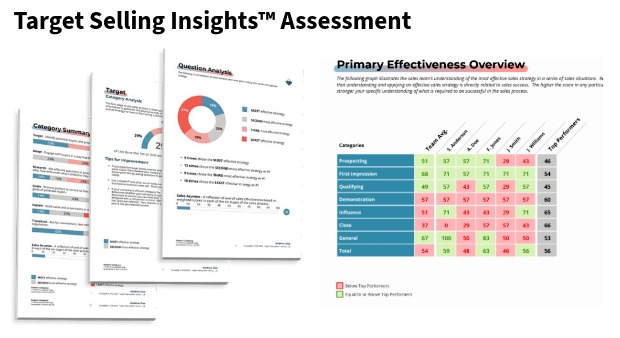
- Primary Effectiveness Overview – Do they recognise the BEST strategy?
This section compares how well individuals understand the most effective strategy across different sales situations.
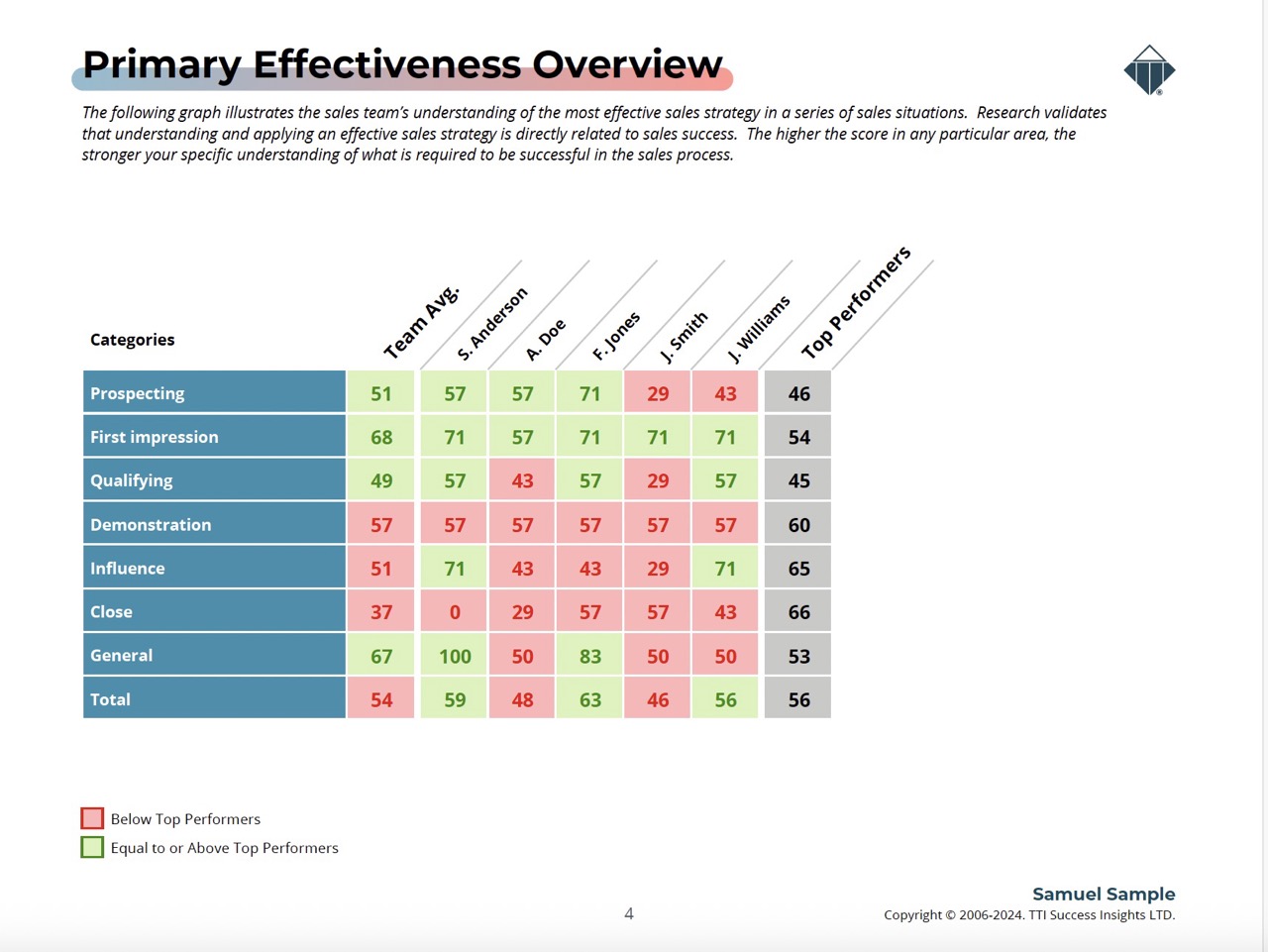
The report displays individual scores, team averages and a reference column labelled Top Performers.
It highlights where the team demonstrates strong sales knowledge and where further development may be needed.
- Primary and Secondary Effectiveness Overview – Do they recognise the BETTER strategies?
This section considers understanding of both the most effective and second most effective approaches.
It provides a broader perspective on knowledge of appropriate sales strategies.
Comparing this view with Primary Effectiveness can provide valuable coaching discussion points about the difference between an acceptable approach and the most effective approach.
- Understanding What Not to Do – Can they recognise INEFFECTIVE strategies?
Knowing what not to do during a sales conversation can be just as important as knowing what to do.
The third overview examines how well individuals recognise strategies that should be avoided.
For example, a salesperson may understand why certain responses to objections, customer questions or negotiations can damage an opportunity.
This section can help managers explore potentially ineffective approaches before those mistakes occur in real customer conversations.
The real advantage: Seeing the whole team in one place
The Group Report enables managers to compare results across the following categories:
Prospecting, First Impression, Qualifying, Demonstration, Influence, Close and General Sales Knowledge.
Individual results, team averages and top-performer reference scores can be viewed side by side.
Instead of asking, “Why isn’t my sales team performing?”, managers can begin asking much more specific questions about where sales strategy knowledge needs strengthening.
Explore the Target Selling Insights Group Report
What a Sales Team Benchmarking Report Can Actually Reveal
Let’s look at an example using the TSI Sample Group Report.
Important: The figures below are taken from a sample report used to demonstrate the assessment. They are not results from an actual DISC Agency client engagement.
The sample report presents the following comparison between a sales team’s average scores and the report’s Top Performers reference scores.
| Sales knowledge category | Team average | Top Performers reference |
| Prospecting | 51 | 46 |
| First Impression | 68 | 54 |
| Qualifying | 49 | 45 |
| Demonstration | 57 | 60 |
| Influence | 51 | 65 |
| Close | 37 | 66 |
| Overall | 54 | 56 |
Source: TTI Success Insights Target Selling Insights™ Sample Group Overview Report, Primary Effectiveness Overview, page 4.
Look closely at those results.
The team demonstrates relatively strong knowledge of first-impression strategies.
Its overall score is also reasonably close to the reference benchmark.
But its closing knowledge score is 37, compared with the Top Performers reference score of 66.
That’s a gap of 29 score points.
Its Influence score is also below the corresponding reference.
Now imagine being the Sales Director reviewing this report.
Without this information, you might assume the team needs more prospecting activity, better presentation skills or general sales motivation.
But the assessment suggests a more specific coaching priority: understanding effective strategies for building value, dealing with buyer resistance and securing commitment.
That is a very different development conversation.
It doesn’t automatically prove that closing knowledge is causing missed revenue targets. Actual sales calls, opportunity data and customer outcomes would need to be examined.
However, it provides a credible starting point for investigating that possibility.
This is the real value of sales team benchmarking: identifying the knowledge gaps worth examining before committing resources to the next training programme.
Download the Sample TSI Group Overview Report (PDF)
Why Account Managers Should Be Assessed, Not Just New Business Salespeople
When people think about sales assessments, they often focus on business development managers, sales representatives and new-business sales teams.
However, experienced account managers also need strong commercial skills.
Maintaining positive customer relationships is important, but account management often requires much more.
Account managers may need to identify growth opportunities, expand relationships, demonstrate additional value, handle competitive threats and negotiate renewals.
Consider an account manager responsible for a portfolio of established customers.
They may be highly regarded by their clients and excellent at responding to requests.
But are they proactively identifying new opportunities?
Do they ask questions that uncover changing customer priorities?
Can they build a business case for additional products or services?
Are they comfortable discussing pricing, challenging assumptions and securing commitments?
There is a significant difference between managing an account and developing an account.
Target Selling Insights can help assess the sales strategy knowledge underpinning those commercial conversations.
For businesses that depend on account expansion, repeat purchasing or long-term customer relationships, that can be extremely valuable.
The assessment does not directly measure every aspect of account management, such as service delivery, retention execution or customer satisfaction. However, it provides a structured assessment of the selling knowledge that supports account growth.
How to Use Sales Assessments to Develop a More Effective Team
Completing assessments and receiving reports should never be the end of the process.
The value comes from how managers use the information.
At The DISC Agency, we recommend approaching sales assessment as the starting point for a structured development programme.
Step 1 – Establish Your Current Position
Begin by reviewing the commercial performance of your team.
Examine metrics such as pipeline quality, conversion rates, opportunity progression, average deal value, win/loss patterns and account growth.
Then arrange for your salespeople or account managers to complete their TSI Individual Assessments.
Where appropriate, combine the results into a Group Overview Report.
This provides a baseline of sales strategy knowledge to review alongside actual commercial results.
Step 2 – Identify the Most Important Development Opportunities
Review the individual and team-level results.
Look for common knowledge gaps and meaningful differences between individuals.
For example, one person may have strong qualifying knowledge but weaker understanding of negotiation and closing.
Another may demonstrate the opposite pattern.
Avoid automatically assuming the lowest score is the only priority. Consider the individual’s role, the importance of each sales stage and what your commercial data is telling you.
Step 3 – Build Personalised Coaching Plans
Use the reports to develop focused coaching objectives for each participant.
For example:
If Qualifying is a development priority: Practise open questions, needs analysis and identifying decision-makers.
If Influence is a development priority: Work on communicating value, providing evidence and responding to objections.
If Closing is a development priority: Practise recognising buying signals, clarifying outstanding concerns and asking for commitment.
The objective is to build practical competence around knowledge gaps rather than simply discuss assessment scores.
Step 4 – Reinforce the Learning Through Real Sales Conversations
Knowledge must translate into action to have commercial value.
Managers should reinforce learning through call reviews, role-plays, account planning, deal coaching and observation of actual customer interactions.
This also helps determine whether the primary challenge is a lack of knowledge, inconsistent application or something unrelated to individual capability.
Step 5 – Review Progress and Reassess
Once targeted coaching has been delivered, review whether the intended behaviours are improving.
Where appropriate, conduct a follow-up TSI assessment to examine changes in sales strategy knowledge.
Compare this with relevant commercial indicators over time.
Improved assessment scores demonstrate a change in measured knowledge. Improved sales results require separate evidence.
The aim isn’t simply to achieve a better assessment score. It’s to develop people who understand effective selling strategies and can put that knowledge into practice.
Should Sales Leaders Use Target Selling Insights or a DISC Sales Assessment?
At The DISC Agency, we offer both the Target Selling Insights Assessment and the TTI Success Insights DISC Sales Profile.
Although both support sales development, they answer different questions.
Target Selling Insights – What does the salesperson KNOW?
TSI focuses on an individual’s understanding of effective sales strategies.
It examines knowledge of prospecting, adapting to buyers, qualifying, presenting, influencing and closing.
Its primary value lies in diagnosing sales strategy knowledge and identifying development priorities.
DISC Sales Profile – HOW does the salesperson naturally approach selling?
The DISC Sales Profile explores behavioural styles and how they may influence the way a salesperson communicates, interacts with buyers and approaches different sales situations.
It provides insight into communication preferences, natural and adapted behavioural tendencies and opportunities to adjust approaches to different customers.
Why combine them?
Imagine a salesperson who understands that they should ask more open questions during discovery but naturally prefers fast-paced conversations and quick decisions.
Their TSI results may demonstrate sound knowledge of effective questioning.
Their DISC Sales Profile may help explain behavioural tendencies that could affect how consistently those strategies are applied.
Taken together, the two assessments can provide a richer basis for coaching.
Target Selling Insights examines sales strategy knowledge. DISC explores behavioural style.
Neither independently guarantees sales success, but both can contribute useful information to an effective sales development programme.
Learn more about our DISC Sales Assessment for Salespeople and Account Managers
Who Should Consider a Sales Team Assessment?
The TSI Individual and Group Reports can be useful across a broad range of industries and sales environments.
They are particularly relevant to organisations with:
- B2B sales teams: Where consultative selling, relationship development and complex decisions are common.
- Account management teams: Where retaining and expanding customer relationships requires effective commercial conversations.
- Business development teams: Where prospecting, qualification and opportunity conversion are key priorities.
- Professional services businesses: Where demonstrating expertise, value and differentiation matters.
- Technical and industrial sales teams: Where salespeople need to connect complex solutions with customer needs.
- Sales teams preparing for training: Where leaders want to identify development priorities before investing in workshops.
- New and developing salespeople: Where a structured understanding of sales strategy can support onboarding and coaching.
The assessment can also be useful for experienced sales professionals.
Experience does not automatically mean an individual has mastered every stage of the sales process.
In fact, experienced salespeople may have highly developed knowledge in certain areas and opportunities to strengthen others.
Five Questions Every Sales Director Should Ask Before Investing in More Sales Training
Before approving another sales development programme, consider these questions.
- Do we understand why different members of our team achieve different results?
Sales targets reveal performance differences, but they don’t tell the whole story.
- Do we know which sales strategies our team understands well and which require further development?
Without assessment, training priorities may be based on opinion rather than evidence.
- Are we investing in training that addresses our actual needs?
A team struggling with closing knowledge may not need another introductory session on prospecting.
- Are our account managers commercially developing their accounts or simply responding to customer requests?
Strong relationships are valuable, but proactive account development requires additional sales capabilities.
- Can we demonstrate whether our training has improved knowledge and practical sales performance?
Establishing a baseline makes it easier to evaluate progress after development activities.
If these questions are difficult to answer, a structured sales skills assessment may be a sensible starting point.
Frequently Asked Questions About Sales Team Assessments
What is the best way to evaluate a sales team?
A comprehensive sales team evaluation should consider both commercial outcomes and the capabilities supporting them. Revenue, conversion rates, pipeline performance and customer retention provide valuable measures of results. A structured sales knowledge assessment such as Target Selling Insights adds another perspective by identifying strengths and gaps in understanding effective selling strategies.
Can Target Selling Insights assess account managers?
Yes. The assessment can be used with account managers to evaluate their understanding of sales strategies relevant to identifying opportunities, asking effective questions, presenting solutions, building value and negotiating commitments. It should be combined with other measures when evaluating broader account management performance.
What is the difference between a sales skills assessment and a personality assessment?
A sales skills assessment such as Target Selling Insights examines knowledge of effective sales strategies. A behavioural assessment such as DISC explores how people tend to behave and communicate. The two approaches answer different questions and may complement one another in sales coaching and development.
How long does the Target Selling Insights Assessment take?
The TSI Individual Assessment contains 48 scenario-based questions and generally takes approximately 45 minutes to complete.
Can I benchmark my entire sales team?
Yes. Once individual assessments have been completed, the TSI Group Overview Report can compare results across participants and display team averages alongside the report’s top-performer reference benchmarks. This helps identify both individual and team-wide knowledge development opportunities.
Can Target Selling Insights identify why my sales team isn’t achieving its targets?
The assessment can identify sales strategy knowledge gaps that may contribute to performance challenges. However, it does not diagnose every cause of underperformance. Sales execution, motivation, lead quality, pricing, competition, product fit and market conditions should also be considered.
Can we use TSI before and after sales training?
Yes. TSI can be used to establish an initial understanding of sales knowledge and reassess knowledge after development. Results can be reviewed alongside observed behaviours and commercial performance to evaluate the broader effect of training.
Is Target Selling Insights suitable for hiring salespeople?
TSI may provide useful additional information about a candidate’s understanding of sales strategies. However, it should not be used as the sole basis for a recruitment decision. Role requirements, interviews, work samples, experience and other relevant evidence should also be considered.
Can The DISC Agency help us assess a sales team anywhere in Australia?
Yes. The DISC Agency works with organisations throughout Australia, including Melbourne, Sydney, Brisbane, Perth, Adelaide, Canberra, Hobart and regional locations.
Individual assessments can be completed online, with opportunities to discuss broader sales team development and facilitated workshops.
Stop Guessing Where Your Sales Team Needs Improvement
If your organisation is investing in sales training, employing experienced salespeople and generating opportunities but still not achieving the results you expect, it’s worth examining what your team actually knows about selling.
Not every performance problem is a sales knowledge problem.
But when gaps do exist, recognising them early provides an opportunity to improve how your people are coached and developed.
The Target Selling Insights™ Individual Assessment helps identify each salesperson’s strengths and opportunities to improve their understanding of effective sales strategies.
The Target Selling Insights™ Group Overview Report adds another dimension, providing a comparative view of sales strategy knowledge across the team.
Together, these reports can help sales leaders move from broad assumptions to more informed development decisions.
Instead of asking everyone to work harder, you can start identifying where people need to work smarter.
Instead of delivering the same training to every salesperson, you can focus on the knowledge and skills that matter most.
And instead of relying exclusively on sales results to understand your team, you can examine the capabilities underpinning those results.
Better sales development starts with better insight.
Ready to Benchmark Your Sales Team or Account Managers?
At The DISC Agency, we help Australian organisations assess and develop their salespeople, business development professionals and account managers using TTI Success Insights assessments and practical sales development programmes.
Whether you have a small account management team or a larger national sales force, we can help you explore the appropriate individual assessments, team reports and development options.
Start by reviewing our sample reports:
Download the TSI Individual Assessment Sample
Download the TSI Sales Team Group Report Sample
Download the Target Selling Insights Assessment Guide
You can also explore our Sales and Account Management Workshops to learn how assessment insights can support practical sales development.
Contact The DISC Agency to discuss evaluating your sales team.
Phone: 1300 690 469
Email: support@thediscagency.com.au
Website: www.thediscagency.com.au
John Wright is Managing Partner at The DISC Agency and holds CPBA, CPEQA and CPMA credentials. The DISC Agency is an accredited TTI Success Insights provider, specialising in behavioural assessments, sales and account management development, leadership and facilitated team workshops across Australia and New Zealand.